
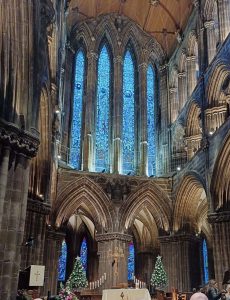
 Despite a decidedly cold day, church and civic representatives gathered at Glasgow Cathedral for the annual service to honour the city’s patron saint, St Mungo, organised by Glasgow Churches Together and the Cathedral community.
The representatives bravely processed from the St Mungo Museum, led by piper Willie Park, behind a copy of the Gospels and an icon of St Mungo. When the icon was placed on the sanctuary and the Gospels on the lectern there, Bailie Norman MacLeod proclaimed the city’s motto “Let Glasgow flourish” to the responses from the congregation “by the preaching of His word – by the praising of His name”.
Outside may have been freezing but inside the Cathedral was made warm by the welcome of the Cathedral community, expressed by Rev Mark Johnstone, the Minister of the Cathedral, and by the lovely blend of readings, music and prayer in honour of St Mungo which followed.
There was Jim Carruth, Glasgow’s Poet Laureate, with his short poem The Bird that never flew. Then the children of St Denis’s Primary School – including some of the wee first year pupils – gave us songs in praise of Mungo, Enoch and Glasgow, with never a piece of paper in sight as they sang with gusto.
After the scripture readings and psalm, Professor Roger Sturrock, Moderator of the Glasgow Presbytery of the Church of Scotland opened his reflection with a greeting in Welsh which he translated for the congregation – God loves you – explaining that this phrase in the earlier form of Welsh or Brythonic used in St Mungo’s time in the central parts of Scotland would surely have been said by St Mungo.
Professor Sturrock pointed out that St Mungo, although of royal blood, did not seek power but became a missionary, converting many by his preaching and his way of life. The Gospel passage which had just been read contains Jesus’ great commandment to love one another. This love is an active and positive love, shown by Mungo in his life of service for others, expressing his love for God. Our city’s motto is a challenge for us to show love in turn in our lives, even for those we find difficult to like or get on with.
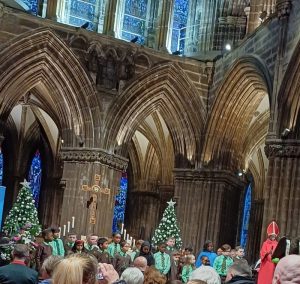
The children of St Denis’s Primary School, with introductions being made by “St Mungo”!
Carissa Swan provided a gentle musical background on clarsach to the congregation’s own reflection on Professor Sturrock’s words, before the St Mungo Singers led them into the Intercessions. In this year of such tragic wars and fighting, we prayed for peace, for an end to the war in Ukraine, the terrible conflict in Gaza.
We also prayed for a welcome for all refugees, remembering that St Mungo in his own time had been a refugee, and that world leaders would not, in their preoccupations with war, forget the care of our wonderful world.
It was appropriate that the choir of the Ukrainian Parish of the Presentation of our Lord, Glasgow now sang two hymns, one of which was a very venerable one which sought from God protection, unity and strength for Ukraine.
Appropriately too, the collection this year was for work with Ukrainian refugees living in Scotland. A lightening of the perhaps sombre mood was provided during this collection by the playing of the Kilmarnock Salvation Army Band.
As the service drew to a close, Bailie Norman MacLeod, on behalf of the Lord Provost of Glasgow, expressed his pleasure at being present to celebrate the memory of the city’s patron saint and founder in the Cathedral which was the oldest building remaining in the city.
He thanked all who had taken part in the service, particularly the Ukrainian choir and the children of St Denis’s and invited everyone to look forward to 2025 when the city would be celebrating 850 years since its creation as a bishop’s burgh. The faith communities, he acknowledged, had played a central role in Glasgow both in its past and in its present, in providing service to all its people.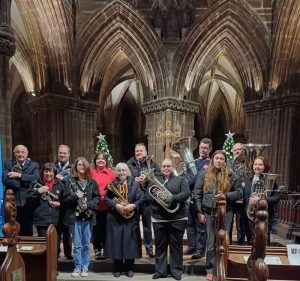
The service ended with Let Glasgow Flourish, the solemn blessing by the representatives of the churches and the wonderfully uplifting hymn Tell out, My Soul, the Greatness of the Lord. The civic and church representatives then descended to the tomb of St Mungo, led by the children of St Denis’s, to lay wreaths at the tomb.

