
As part of the year long celebrations to mark the 850th anniversary of Glasgow becoming a burgh in 1175, the community of Glasgow Cathedral, Glasgow Churches Together (GCT), and
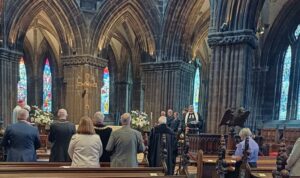
Welcome by Rev Mark Johnstone
church and civic leaders came together on 11 May to celebrate the first Archbishop of Glasgow, Robert Blacader (or Blackadder).
Before the service began, harpist Catherine Walker played in the beautifully restored Blacadder Aisle. Church and Civic representatives then processed to the Cathedral, led by Piper Willie Park. As they moved into the choir and sanctuary, the congregation, led by the St Mungo Singers, sang the inspiring All People that on Earth do Dwell.
Rev Mark Johnstone, Minister of the Cathedral, welcomed everyone to the celebration and thanked Ecumenical Officer Elspeth Glasgow of GCT for pulling things together so that all could be one on this day. The service then began with the singing of the lovely Brother James’ Air before the opening prayer, led by Capt. Les Heal, Chair of GCT.
The highlight of the service followed: the reading, in Latin and English, of the Will of Archbishop Balcader. It was a fascinating insight into the times, and the mind, of the Archbishop, and included detailed instructions for the location of his burial. Sadly those instructions could not be carried out as Archbishop Blacader died on his way to the Holy Land on pilgrimage and was buried at sea.
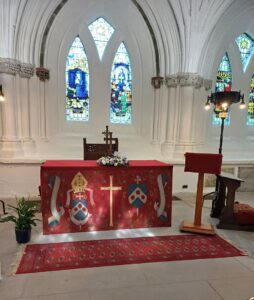
The Altar Table in the restored Blacader Aisle
Archbishop Bill Nolan, in his reflection, spoke of some of those who had been his predecessors as bishops/archbishops in Glasgow:-. the 12th century Bishop, Jocelyn who, as well as commissioning the Life of St Mungo, persuaded the King of his time to grant Glasgow the status of a Bishop’s burgh (now being marked by Glasgow’s 850 celebrations) and the Pope to give Glasgow a special position in relation to Rome; Archbishop Blacader, in the 15th century, who became the first Archbishop of Glasgow in 1492, much trusted by King James IV in affairs of state who was tasked with finding a bride for the King, with the resulting marriage of King James with Margaret, the daughter of Henry VII and the signing of a Treaty of Perpetual Peace in 1502 (the Treaty did not last but one lasting outcome was the Union of the Crowns on the succession of James VI of Scotland to the throne of England); and the first Archbishop after the restoration of the Hierarchy in Scotland, Archbishop Eyre who was from York, who, like many of his predecessors , was much involved in civic as well as spiritual affairs, and, at a time of tensions between Scottish and incoming Irish Catholics, was seen as an impartial referee and, among other acts, set up an education college in Glasgow.
Archbishop Nolan suggested that we today can learn much from these bishops and the benefits they brought, not just to the church, but also to the city.
The service continued with the St Mungo Singers leading the congregation in the singing of a simple plainchant Agnus Dei which felt so right in the mediaeval Cathedral, followed by prayers of intercession for the city and its citizens and their future,
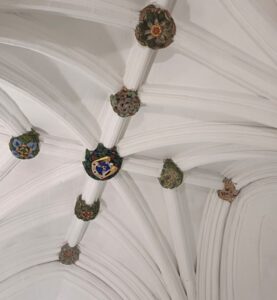
A detail from the roof of the Blacader Aisle
and concluding with the singing of the Lord’s Prayer.
Our Father in heaven
Before the final blessing and the closing hymn, a message from the City Council was read which acknowledged the work of the churches and their leaders in their unwavering dedication and commitment to the community.The hymn which closed the service, John Bell & Graham Maule’s challenging Will you come and follow me? was a fitting response.
There was an opportunity after the service for members of the congregation to visit the renovated Blacader Aisle and admire its simple beauty.

